




Chevrolet Super Cruise is a hands free driver assistance system designed to reduce driver workload during highway driving while keeping the driver fully responsible for the vehicle. It is not self driving and it is not autonomous. Instead, Super Cruise uses a tightly controlled combination of mapping data, vehicle sensors, and driver attention monitoring to allow hands free steering on specific highways when all operating conditions are met.
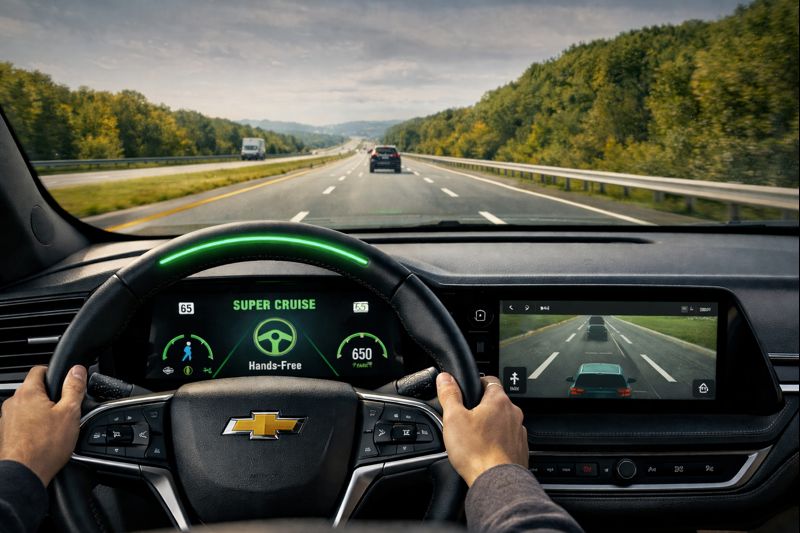
Understanding Super Cruise requires separating marketing shorthand from real system behavior. This technology is engineered around safety validation, redundancy, and driver accountability rather than independence from the driver.
What Chevrolet Super Cruise Actually Is
Super Cruise is classified as a Level 2 driver assistance system. This classification means the vehicle can assist with steering, acceleration, and braking simultaneously, but the driver must remain attentive and ready to take control at all times.
Key characteristics of Level 2 driver assistance include:
- Hands free steering capability under defined conditions
- Continuous driver monitoring
- No independent decision making outside the programmed environment
- Immediate driver takeover required when system limits are reached
Super Cruise differs from basic lane keep assist systems because it provides continuous steering control rather than intermittent corrections. However, that capability only exists when the system can confirm road type, vehicle position, and driver attention simultaneously.
How Super Cruise Works at a System Level
Super Cruise relies on a layered system architecture. Each layer must independently validate safe operation before hands free steering is allowed.
Core system components include:
- LiDAR based high definition road maps
- GPS positioning with lane level precision
- Forward facing cameras for lane tracking
- Radar sensors for distance and speed monitoring
- An infrared driver attention camera
- Vehicle control modules managing steering, braking, and throttle
If any one of these components cannot confirm proper conditions, Super Cruise disengages and returns control to the driver.
Why LiDAR Mapped Roads Are Required
One of the most important distinctions of Super Cruise is its reliance on pre mapped highways. General Motors uses LiDAR scanning to create highly detailed three dimensional maps of approved divided highways.
These maps allow the system to:
- Confirm exact lane geometry
- Anticipate curves and elevation changes
- Validate road boundaries beyond camera visibility
- Maintain accuracy when lane markings are faded or inconsistent
Super Cruise will not activate on city streets, two lane roads, or unmapped highways because those environments introduce variables that cannot be reliably validated for hands free steering.
Driver Attention Monitoring and Enforcement
Hands free does not mean eyes free. Super Cruise uses an infrared camera mounted on the steering column to track head position and eye movement in real time.
The system verifies that the driver is:
- Facing forward
- Visually engaged with the road
- Alert and responsive
If driver attention drops, the system escalates warnings in stages:
- Visual alerts through the steering wheel light bar
- Audible alerts
- Seat vibration
- Eventual system disengagement if ignored
If the driver does not respond, Super Cruise will slow the vehicle and bring it to a controlled stop while activating hazard lights. This enforcement process is a critical safety element and a key differentiator from systems that rely only on steering wheel input.
When Hands Free Steering Is Allowed
Super Cruise activates only when all required conditions are satisfied:
- The vehicle is traveling on a compatible divided highway
- Lane geometry and road data are confirmed
- Camera visibility is sufficient
- The driver attention system confirms engagement
- No system faults are present
When active, the steering wheel light bar turns green, indicating hands free steering is permitted. If conditions change, the system immediately alerts the driver and requires hands on control.
Is Super Cruise Fully Autonomous
No. Super Cruise is not autonomous driving.
It cannot:
- Navigate city intersections
- Respond to traffic signals
- Handle construction zones independently
- Make route decisions
- Replace driver responsibility
The system is designed specifically for controlled highway environments, where predictable road geometry allows assistance without removing the driver from the control loop.
Subscription and Ownership Considerations
Most Chevrolet vehicles equipped with Super Cruise include a limited trial period. Continued use after that period typically requires a subscription.
Important ownership considerations include:
- The hardware remains installed in the vehicle
- Functionality is enabled through software
- Subscription status determines feature availability
Shoppers evaluating Super Cruise should factor long term access into ownership planning rather than assuming permanent availability.
Super Cruise Compared to Other Hands Free Systems
Super Cruise is often compared to Tesla Autopilot, but the systems differ significantly in design philosophy.
Key distinctions include:
- Super Cruise operates only on pre mapped highways
- Tesla systems rely more heavily on vision based interpretation
- Super Cruise enforces driver attention using eye tracking
- Tesla primarily monitors steering wheel input
These differences reflect General Motors’ focus on controlled environments and active safety enforcement rather than broad autonomy claims.
Who Super Cruise Is Designed For
Super Cruise is best suited for drivers who:
- Spend significant time on interstate highways
- Want reduced steering workload during long trips
- Prefer clearly defined system boundaries
- Value enforced driver engagement for safety
It is not intended for drivers expecting hands free operation in urban or unpredictable environments.
The Broader Role of Super Cruise in Chevrolet Technology
Super Cruise represents Chevrolet’s approach to driver assistance as a support system rather than a replacement for the driver. By limiting operation to environments where safety can be validated and enforcing continuous attention, the system prioritizes fatigue reduction without compromising responsibility.
For shoppers evaluating advanced driver assistance features, the most important factors are where the system works, how it monitors safety, and what role the driver continues to play. Super Cruise is most effective when understood and used within those boundaries.
Connect with us

